

When a flat roof keeps leaking but the failure cannot be seen, patching gets expensive without fixing anything. ELD tests the membrane itself and marks the exact points where it has failed, so the repair goes where the water is getting in. From £450 for a domestic flat roof up to 40 m², booked online.
Electronic leak detection that finds the breach
Flat roof leak testing London ⸻
UK’s trusted damp & mould survey
Quickly resolve your
damp and mould issue
Don’t let prolonged moisture damage your home or health. Damp Surveyor Near Me pinpoints what’s driving the damp and mould, giving you a clear roadmap to a dry, safe home, without the guesswork.
Stop patching
the possibilities
Whether it’s black mould, a musty smell, staining, or peeling paint, we identify the moisture driver and set out the remediation sequence- so landlords, contractors, and residents align smoothly.
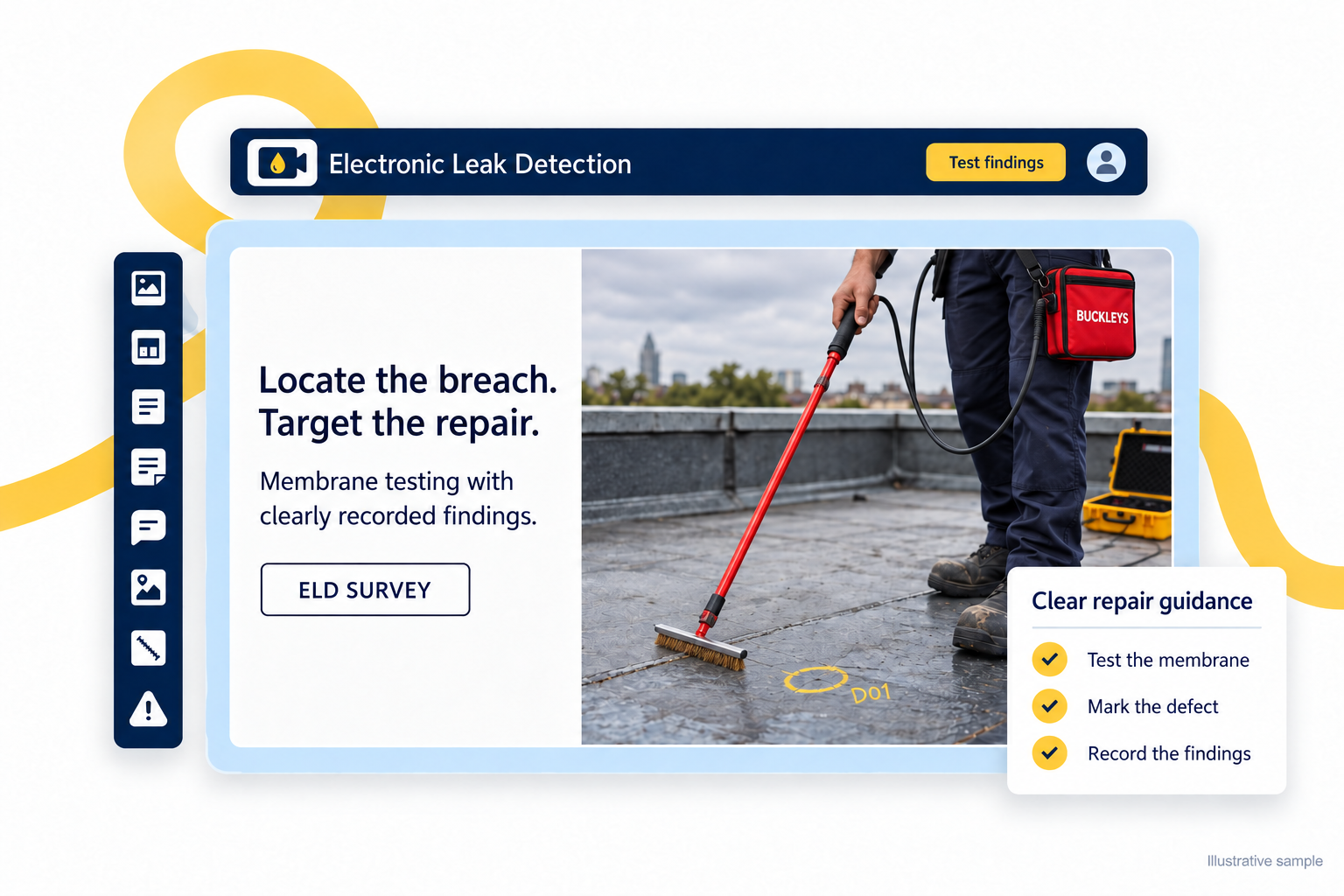
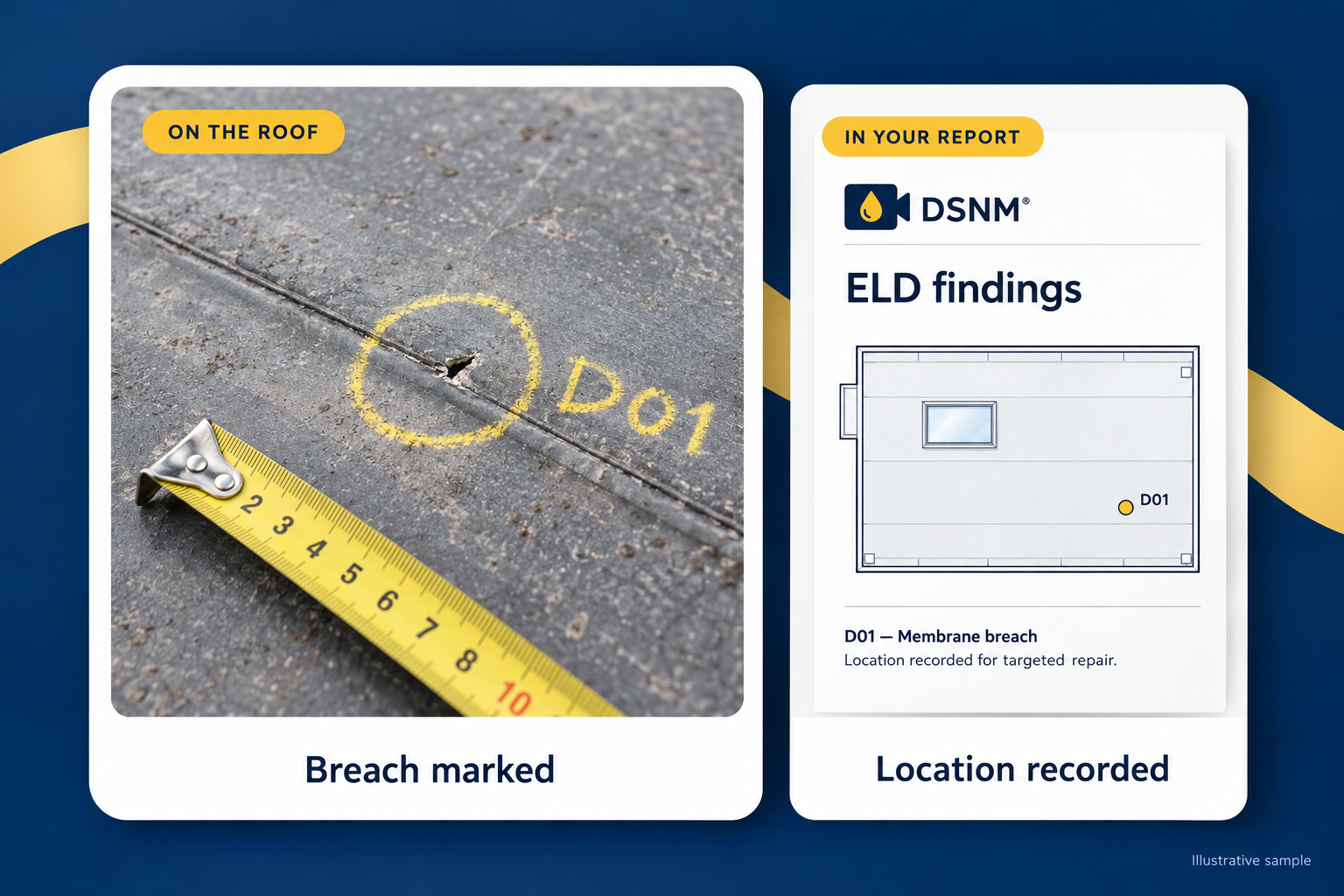
Water entering through a membrane travels beneath the surface before it shows inside - the stain is rarely under the breach. ELD moves the investigation from possible repair areas to recorded breach locations, marked on the roof and plotted on a plan.
Go from damp and mould to peace of mind in no time
Membrane integrity evidence – not another patching quote
A proper leak test is not a glance at the felt followed by a quote. It is a controlled electrical test of the whole membrane, read by a surveyor who is not selling the repair.
Locate the breaches
ELD finds breaches and failed laps that cannot be seen from the surface - down to pinhole size - including the ones nowhere near the stain inside.
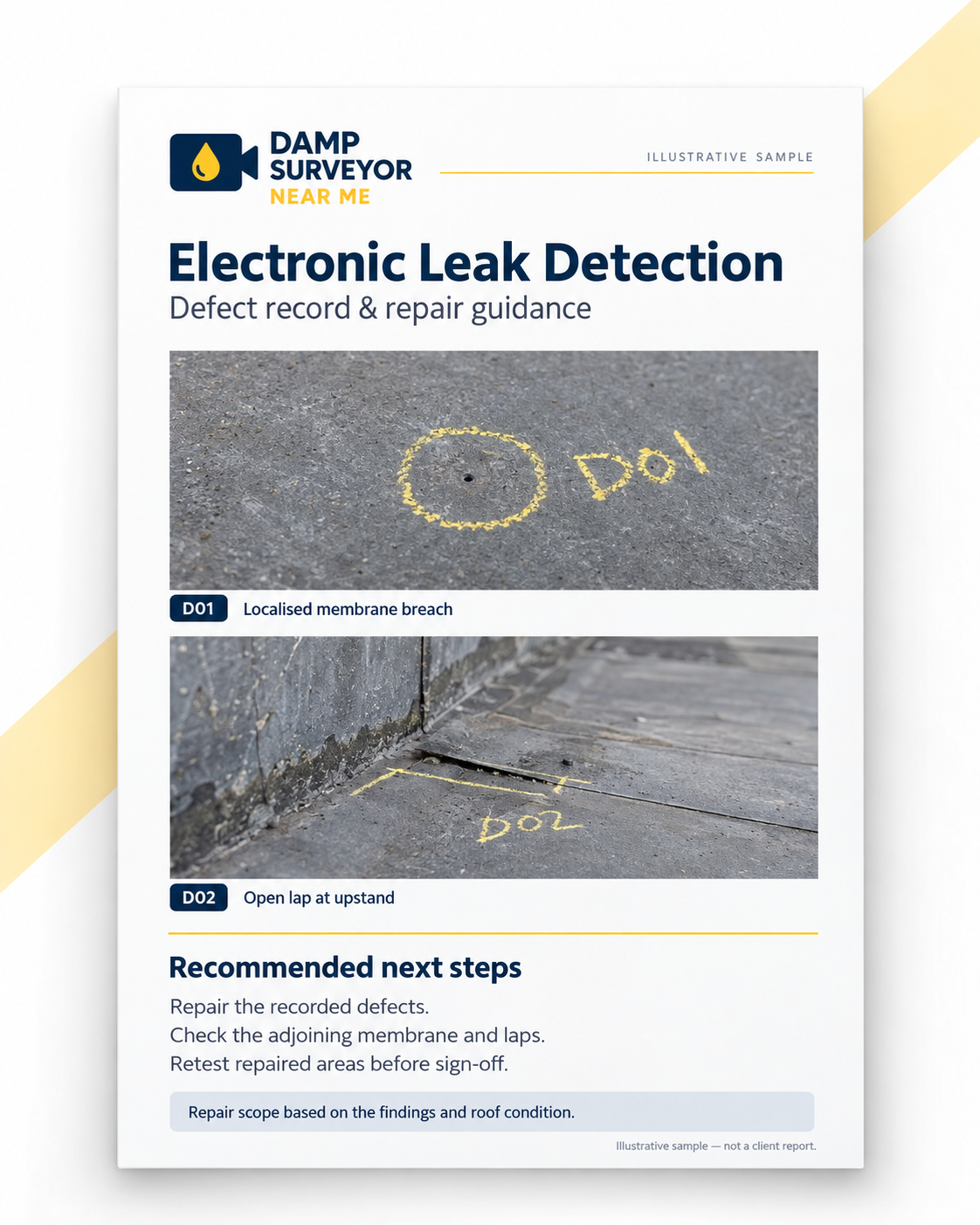
Every detected location is marked on the roof and photographed, so attention goes to recorded positions instead of opening or patching broad areas on guesswork.
Narrow the repair
The report separates the breaches letting water in from the incidental ones, and says whether a targeted repair, a re-cover or replacement is justified.
Give the contractor a plan
Book the test before the next repair, not after it
Inspect and solve your damp and mould faster than ever
A leak that keeps coming back, a stain after a storm, a roofer recommending a new roof - the test shows whether the membrane has failed in a handful of places or everywhere, before money goes on the wrong job.
If mould keeps returning, plaster keeps bubbling or “repairs” haven’t worked, it’s usually because the driver hasn’t been traced to the root source. We’ll find it and set out the fix order.
Trusted where decision matters
Over 15,000 residential and commercial properties rely on Damp Surveyor Near Me to secure asset value using damp and mould surveys

Some roofs have one puncture under a plant pot. Others have failed laps along every upstand. Either way, the process stays simple and the report stays clear.
A simple path from concealed breach to targeted action
A simple path to fix damp and mould, however complex
Some cases are straightforward ventilation management. Others involve hidden leaks, cold-bridge moulding, or rising damp. Either way, we keep the process simple and the report clear, so you can take control of your damp instantly.
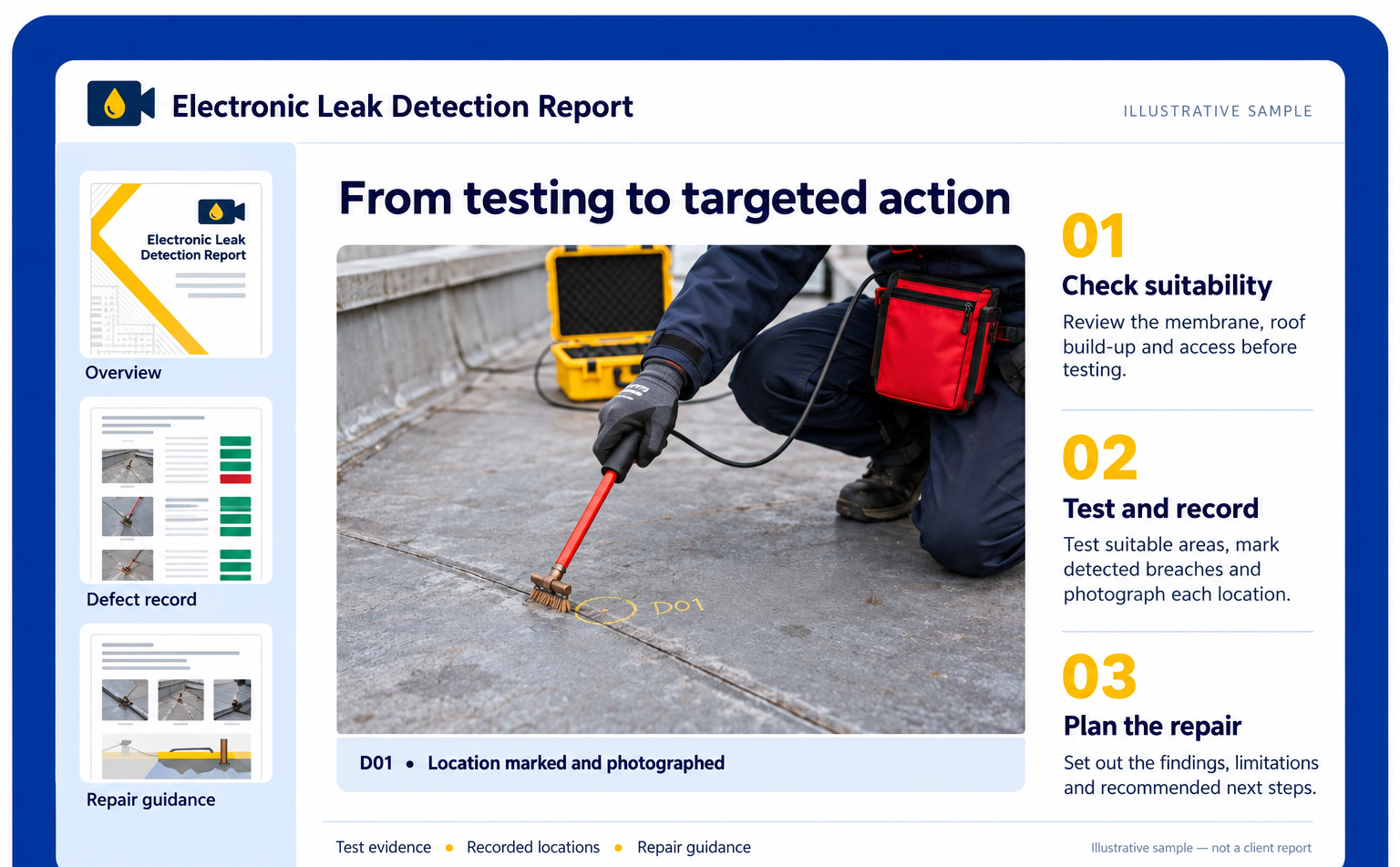
Findings explained on the day; the written report within 48 hours – the method, the conditions, every breach on a plan with photographs, and the repair in the right order.
Book online, answer a few questions about the roof and send a photo. Membrane, deck, coverings and access are confirmed before the visit, the date is set against a dry forecast.
Get a specialist on site
fast
Get a specialist on site fast
Get an in-person inspection that replaces guesswork with proper checks, readings, and context- so the real driver can be identified, not assumed.
Receive an evidence-led report
Walk away with a decision-grade report in less than 48 hrs: annotated photos, clear reasoning, and a simple action order- so you can point to facts, not opinions.
Act with every stakeholder aligned
Use the report to coordinate whoever’s involved- landlord, managing agent, contractor, or housing team- so the right work happens in the right order.
Receive an evidence-led report
Act with every stakeholder aligned
Forward it to a roofer, managing agent, freeholder or insurer. Recorded locations
give the contractor a defined brief – and a fairer quote.

“We needed to identify the root cause of damp for a high profile case, and Damp Surveyor Near Me was perfect for a comprehensive damp and mould survey, fast.”
Alex Gillbert
Director of Earthlings

Not sure it's the membrane? Send photos of the stain and the roof on WhatsApp and the right investigation - ELD, roof survey, drone or damp and mould survey - is recommended before anything is booked.
Start damp assessment for free
Start damp assessment for free
Get initial free assessment to discuss your damp & mould problem and explore your options, without commitment.
Electronic leak detection FAQs
How much does electronic leak detection cost in London?
From £450 for a domestic flat roof up to 40 m² - a typical extension, back addition or balcony - booked online, including the test, every detected breach marked on the roof, and the written report. Published UK prices for the same test run from £395 to £500, and the cheaper end is roofers recovering the fee on the repair. Larger roofs, blocks and commercial sites are priced from the roof area and access, including any equipment the inspection needs, and quoted before booking.
How does electronic leak detection work?
A waterproof membrane is an electrical insulator; the deck beneath it is not. Under the ASTM D7877 standard the method is built on, a controlled charge is applied across the membrane and wherever it has been breached - a puncture, a split, a failed lap, a pinhole - the current finds a path through, and the instrument registers exactly where. Two methods are used: a low-voltage test on a lightly wetted membrane, and a high-voltage brush test at 15,000-40,000 volts on a dry one. Both are non-destructive and neither needs the roof flooded. Each breach is marked on the roof and plotted on a plan.
Which roofs and membranes can be tested?
Flat and low-pitch roofs, terraces and balconies with felt and bitumen, single-ply PVC and TPO, GRP, liquid-applied, mastic asphalt or hot-melt membranes - any membrane that does not conduct electricity. Two things cannot be tested: black carbon-filled EPDM rubber, which conducts and defeats both methods, and any area covered by paving, ballast or a green roof, because the test cannot read through overburden - that area is cleared first. The deck beneath has to carry the charge: concrete and metal do; on a timber-decked roof that is leaking, the water that has come through gives the path and the earth is made from inside. The booking questions identify all of this before the visit.
Will you need to come inside?
Usually, yes. The test needs an earth connection beneath the membrane. On a concrete or metal deck that is made from the roof; on a timber-decked extension - most London back additions - it is made from inside, through a small opening in the already-stained ceiling where the leak shows, agreed at booking and sitting where the ceiling will be repaired anyway. Booking confirms which applies, so access is arranged before the visit and nobody is surprised on the day.
How accurate is electronic leak detection?
It locates breaches down to pinhole size and marks each one where it is, which flood testing, dye and thermal imaging cannot do - that is why ELD is specified as the quality-control test on new membranes and is faster, more accurate and cheaper than the alternatives on most roofs. Accuracy depends on doing it properly: the right method for the membrane, the voltage set for its thickness, a dry surface for the high-voltage test, and a surveyor who then separates the breaches letting water in from the incidental ones. The report records the method, the conditions and every location, so the result can be checked.
Does electronic leak detection work on an old roof?
Yes - the test finds breaches regardless of the membrane's age. What changes is the advice. A felt roof past fifteen years with a history of patching can reach the point where another repair is money spent twice, and specialist firms say so: a membrane ten years old with previous patches, or fifteen years old regardless, may be at the end of its life. The report says plainly whether the breaches found justify a targeted repair, a localised re-cover or replacement - and because no repair is sold, that view is not shaped by the work that follows.
Can you test under paving, decking, ballast or a green roof?
Not through them. Neither test method can read through overburden, so paving, decking, gravel or planting over the membrane has to be lifted from the area to be tested before the visit - the booking questions ask what is on the roof so this is arranged, not discovered. On a new green roof the membrane is tested before the overburden goes on, and a permanent trace wire can be laid under it so the roof can be re-tested later without lifting anything. Larger terraces and podiums are quoted with the clearance in mind.
How long does it take, and when is the report?
A typical domestic flat roof is tested in a single visit of a few hours, with the findings explained on the day and the written report within 48 hours. The high-voltage test needs a dry membrane, so visits are planned against the forecast and moved to the next dry slot at no cost if it rains - a test done on a wet roof in the wrong method is a test done twice. Larger roofs may take a full day.
What else could be causing a flat-roof leak?
ELD tests the membrane. Water can also enter through failed flashings, cracked parapets, blocked outlets, defects in the walls around the roof, or from plumbing above - a bathroom, a tank, a pipe in the ceiling void - none of which the membrane test is designed to find. A roof survey examines the flashings, parapets and outlets at close range, drone inspection covers the parts that cannot be reached, and where the water shows as damp or mould inside, the damp and mould survey connects the roof to what is happening below. ELD is for waterproofing membranes, not pipework.
Does the test show how much water is already in the roof?
It pinpoints where water is getting in; it does not measure how much the build-up beneath has absorbed. Where the deck and insulation have been holding water for some time - a soft deck, a sagging ceiling, a roof that drips long after rain - the surveyor flags it in the report, so the repair specification covers drying or replacing the saturated area and not just sealing the breach. Where that matters, the damp and mould survey adds the moisture readings inside.
Is ELD included in the damp and mould survey?
No. It is a separate specialist test with its own booking and price. Roof checks within the damp and mould survey and the roof survey are made from the ground, windows, garden and loft; the membrane itself is only tested electrically when ELD is booked. The two are booked together where a flat roof and internal damp are both in question, so the breach locations and the moisture evidence inside are read as one investigation.
Why not a roofer's free leak check?
Because a free check is paid for by the repair it recommends, and some firms say so - the survey fee is credited against the works, or a repair voucher comes with the test. A roofer also looks for what can be seen; ELD finds the breaches that cannot be, including the ones nowhere near the stain. Damp Surveyor Near Me carries out no roofing work, so the report says which breaches are letting water in, which are incidental, and whether the roof is worth repairing at all - and the roofer's quote then covers that and nothing else.

